Bali Belly in Lombok: How to Avoid Getting Sick (& What to Do If You Do)
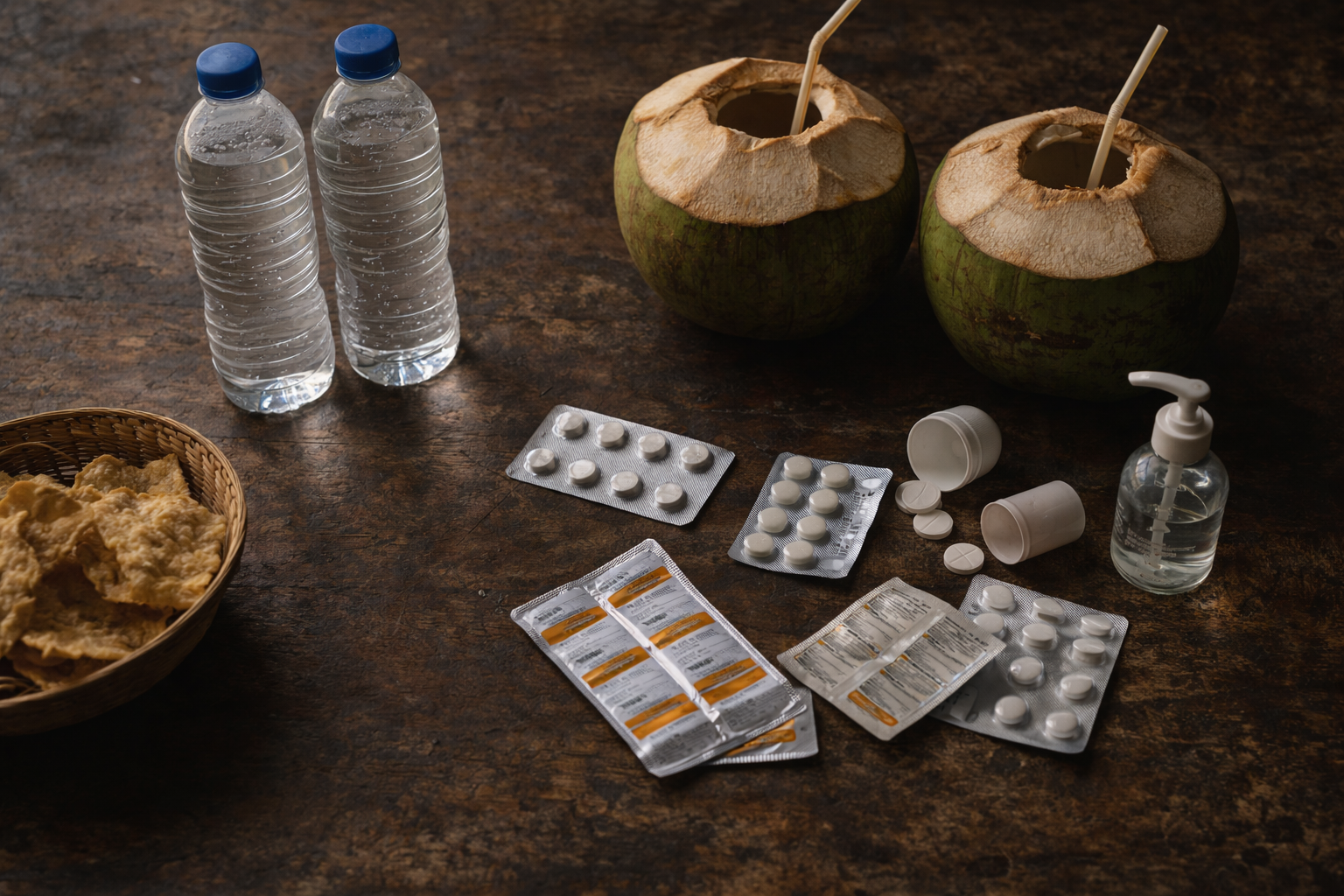
Quick Reference: Bali Belly in Lombok
The essentials at a glance — everything a first-time or returning visitor needs to know before they eat anything.
- 🚰 Never drink tap water anywhere in Lombok, including at 4 and 5-star hotels outside the Mandalika SEZ. Brush your teeth with bottled water. Keep your mouth closed in the shower.
- 🧊 Tube ice (cylinder with a hole through the middle) is safe. Crushed, shaved, or block ice from cheap warungs and beach carts is not. Ask: "Apakah ini es kristal?"
- 🍽️ Busy local warungs cooking to order are often safer than hotel buffets and Padang-style displays. Turnover is your best friend.
- 🍌 Peel your own fruit. Pre-cut plates, smoothie bowls, and juice carts are among the highest-risk items on the island.
- 🧴 Soap and water beats hand sanitiser — especially against norovirus, which alcohol doesn't reliably kill.
- 💊 Pack your kit: Oralit (ORS), loperamide, a probiotic (S. boulardii), and ideally a standby azithromycin script from your travel doctor.
- 💉 Vaccinate before you go: Hepatitis A and typhoid are essential for Indonesia. Consider Dukoral for added ETEC protection.
- 🏥 Nearest international-standard hospital: Siloam Mataram. On the Gilis: no hospital — clinics only, with evacuation to Lombok or Bali.
- 🚨 Go to a clinic if: blood in stool, fever above 38.5°C, symptoms beyond 72 hours, or you can't keep fluids down.
Contents
Bali Belly in Lombok is real, it's common, and it will derail your trip if you're not prepared — but it's also largely preventable with the right information. Most visitors who get sick aren't unlucky. They just didn't know which ice to avoid, or which dishes carry the actual risk.
This guide is written from the ground up for Lombok specifically. The water infrastructure here is different from Bali. The Gili Islands have their own water crisis that changes the calculus entirely. And as a resident, I've seen enough first-timers spend day three of their five-day trip on the bathroom floor to know that a good prevention guide is worth writing properly.
Whether you're here for two weeks of surf and beaches, planning a Mount Rinjani trek, or looking at Lombok as a longer base — read this before you order anything.
What Is Bali Belly?
"Bali Belly" is the Australian-coined nickname for traveller's diarrhoea (TD) — not a specific disease, but a clinical syndrome. The CDC Yellow Book and NaTHNaC define it as three or more loose stools in 24 hours, often with cramping, nausea, vomiting, or fever. It sits under the broader category of acute infectious gastroenteritis.
The "Bali" in the name reflects Australia's proximity and history with that island — but the pathogens, water infrastructure, climate, and food-handling conditions are effectively identical between Bali and Lombok. In some respects, Lombok is a higher-risk environment, particularly on the Gilis and in rural south Lombok. Calling it "Bali Belly" here isn't a marketing hook — it's the same syndrome in a less medically-resourced setting.
What's actually causing it in Southeast Asia
This matters for treatment: Southeast Asia is a Campylobacter region, not an ETEC (E. coli) region like Mexico or North Africa. A US military study in Thailand found Campylobacter in 35% of traveller's diarrhoea cases, with other Thai cohorts reporting up to 62%. This is why ciprofloxacin — the antibiotic many travellers pack — often doesn't work here. Campylobacter resistance to fluoroquinolones in the region runs at 75 to 90%. Azithromycin is the correct first-line antibiotic for Southeast Asia.
Bacteria cause around 80 to 90% of cases. Viruses (norovirus, rotavirus) account for 5 to 15%, and are responsible for the explosive resort-wide outbreaks you'll read about on TripAdvisor. Parasites — mainly Giardia — become a bigger factor the longer you stay. Giardia is the main cause of symptoms that persist beyond two weeks, characterised by bloating, sulphurous belching, and fatigue.
How long does it last?
The honest answer: most cases resolve in three to five days without treatment. Around 12% still have symptoms at one week; fewer than 2% persist beyond 30 days. Norovirus typically clears in one to three days. Giardia, left untreated, can run for weeks to months.
Why Lombok Is a Higher-Risk Environment
Lombok's water story is worth understanding before you arrive. It shapes almost every practical decision you'll make about food and drink on the island.
The water infrastructure gap
Lombok is served by two regional water authorities — PDAM Giri Menang covering Mataram, Senggigi, and West Lombok, and PDAM Amerta Dayan Gunung in the north. Chlorination is inconsistent, pipes are old, and bacterial regrowth in distribution lines is common. Tap water is not safe anywhere in Lombok — not for drinking, not for brushing your teeth, not as ice.
The Mandalika SEZ (the resort zone around Kuta Lombok that hosts MotoGP) has its own reverse-osmosis desalination infrastructure built by ITDC. But the village of Kuta Lombok, just outside the SEZ perimeter, runs largely on wells and truck-delivered water. A 500-metre walk from the Pullman to the main strip crosses a meaningful water-quality divide.
The Gili Islands situation
The Gilis have no natural surface fresh water. Every island's supply is engineered — and precarious.
Gili Meno's situation became acute when the central government revoked the island's sole desalination plant permit in June 2024, after drilling chemicals contaminated nearby reefs and killed an estimated 75% of reef fish abundance in the affected area. Hotels scrambled for alternatives. You can read more at VOI's coverage of the Gili Meno water crisis.
Gili Trawangan relies on desalination, rainwater, and a 2017 underwater pipeline from the mainland Lombok. Budget accommodation often runs salt-water showers. Gili Air has a small freshwater lens in the aquifer, but tourism growth between 2016 and 2019 pushed withdrawals beyond sustainable levels, with seawater intrusion and contamination risk from septic systems sitting directly above the same water source.
The practical implication: on the Gilis, faecal coliforms can reach kitchen wells through a short vertical distance. Ice is barged from the mainland — cold chain can break in transit. And there is no hospital on any of the three islands. Serious cases evacuate by speedboat to Lombok or Bali.
Climate and seasonal variation
Tropical heat — 27 to 33°C year-round — means bacterial doubling time for common food pathogens is minutes. Any cooked food held at room temperature for more than two hours is suspect. Rainy season (October to April) dramatically increases waterborne risk: runoff contaminates streams, waterfall pools, beach drainage, and flooded paddies. Reports of gastro cases spike in January and February. Dry season (May to September) brings cleaner waterfalls but lower wells and saltier Gili water.
How You Actually Get Sick in Lombok
Every transmission route is fundamentally fecal-oral: something with microscopic quantities of infected faeces reaches your mouth. The realistic vectors in Lombok are more specific than the generic "don't drink the water" advice.
Water and ice
Tap water is the baseline risk. The ice distinction is where most visitors go wrong. Indonesia has two categories:
- 🧊 Es kristal / es tabung (tube ice) — cylindrical with a hole through the middle, made by industrial machines from filtered water. This is the safe ice. The hole is a by-product of the manufacturing process.
- 🧊 Es balok (block ice) — made from untreated water intended for chilling fish and produce, then hacked or crushed for drinks at cheap warungs, juice carts, and beach stalls. Skip it.
If you're unsure, ask: "Apakah ini es kristal?" (Is this tube ice?) or order "Tanpa es, tolong" (Without ice, please). Smoothie bowls and fresh juices are a triple risk — tap water for blending, block ice, and pre-cut fruit. Only order them at places that open whole fruit in front of you and visibly use tube ice.
One underrated vector: refilled bottled water. Always check the seal before drinking — you should hear an audible crack or snap when opening. If the cap spins freely, reject it.
The riskiest dishes in Lombok
Lombok food is genuinely one of the best reasons to visit — and the goal here isn't paranoia, it's calibration. Most of the risk sits in specific dishes, not in eating local food across the board.
- 🌶️ Sambal matah — the raw shallot, lemongrass, chilli, and terasi sambal that comes with ayam taliwang and grilled fish. Made in the morning, sits at room temperature all service. The dish itself is often fine; this is the risk.
- 🥗 Beberuk terong — raw diced eggplant, long beans, and tomato with raw sambal. Nothing is cooked. One of the highest-risk items on a standard Sasak plate.
- 🥬 Plecing kangkung — blanched water spinach served cold with raw sambal plecing. Many traveller Bali Belly cases trace back to this dish specifically.
- 🥩 Satay (sate rembiga, sate bulayak, ayam satay) — grilled fast over fierce embers, which can char the outside before the inside reaches temperature. Ask for it kering or matang (well done / fully cooked).
- 🍚 Nasi balap puyung — the shredded chicken is cooked once and portioned all day at room temperature. At the high-turnover flagship stalls near Praya airport (Inaq Esun, Rumah Makan Cahaya), the risk is manageable. At roadside copies, less so.
- 🥗 Lalapan — raw cucumber, cabbage, long beans, and basil, washed in tap or well water. Skip unless you'd stake a day of your trip on the place.
Hotel and resort buffets are not a safe default. The CDC explicitly flags buffets as high-risk because food sits in the temperature danger zone (4–60°C). Power dips are common in Senggigi and Kuta during rainy season — brief outages drop bain-maries below 60°C, and bacterial growth resumes.
Waterfall swimming and ocean water
If you're planning to visit Sendang Gile or Tiu Kelep waterfalls in North Lombok (covered in our Rinjani trek guide), local operators sometimes claim the spring water is safe to drink at source. Treat that claim with scepticism — the trail passes through agricultural land, villages, and monkey habitat. The risk is swallowing water when jumping in, not swimming itself. After heavy rain, avoid the pools for 24 to 48 hours.
Ocean water near populated beaches warrants similar caution. Senggigi's main beach sits below the strip's drainage — visible brown plumes appear after rain. Locals swim at Mangsit or Nipah instead. On the Gilis, the harbour swim area on Gili T has high boat traffic and day-tripper pollution; the sunset side is cleaner.
How to Avoid Bali Belly in Lombok
Water — the single highest-leverage decision
Aqua (Danone) is the default — 93% of Indonesian consumers identify it as their primary water brand, with near-universal distribution. Le Minerale is the reliable second choice; its hard plastic seal makes an audible crack on opening, which is your best defence against refill fraud. Buy from Indomaret, Alfamart, Circle K, or hotel reception — not from unattended roadside stacks.
Three non-negotiable rules: never drink tap water, never brush your teeth with it, and don't rinse your toothbrush under the tap afterwards. Keep a small Aqua on the bathroom sink as a reminder. Keep your mouth closed in the shower.
If you want a purification backup, the Grayl Geopress is the most traveller-friendly option for Southeast Asia because it removes viruses as well as bacteria and protozoa — a meaningful distinction in Indonesia where hepatitis A, rotavirus, and norovirus circulate in contaminated water. LifeStraw and Sawyer filters are hollow-fibre only, which means they miss viruses.
Reading a warung for safety signals
The mid-tier busy local warung cooking to order is often safer than the empty mid-range tourist-facing restaurant. What to look for:
- ✅ High customer turnover — food doesn't sit. A packed local place at lunchtime is a strong positive signal.
- ✅ Visible cooking setup — wok fires, grilling, frying to order in front of you.
- ✅ Refrigerated or actively iced meat storage with high cycling.
- ❌ One person handling cash and food with the same hands.
- ❌ Shared chopping boards for raw and cooked meat.
- ❌ Food displayed at ambient temperature in a glass case.
When exploring the food scene in Kuta Lombok — which is genuinely excellent — our Best Eats in Kuta Lombok guide covers our picks for spots that consistently deliver on both quality and food safety basics.
Fruit — the simple rule that works
The CDC rule is blunt and correct: peel it yourself or skip it. In Lombok, your safe fruit list reads well: pisang (banana), mangga (mango), rambutan, manggis (mangosteen), salak (snake fruit — a Lombok speciality), pepaya if whole, jeruk bali (pomelo). Pre-cut fruit plates, smoothie bowls, and fruit carts with pre-peeled slices are high risk regardless of how reputable the venue looks.
Hands
Soap and water for 20 or more seconds remains the most effective single intervention. The norovirus caveat matters: alcohol-based hand sanitiser does not reliably kill norovirus because it's a non-enveloped virus that resists alcohol. Soap physically removes it. Don't rely on sanitiser alone, especially at resort buffets where norovirus outbreaks are a documented risk. Critical moments to wash: before every meal, after handling rupiah banknotes, after public transport, after markets, after public toilets.
Before you arrive: vaccinations and gut prep
Hepatitis A is essential for Indonesia — two doses, around 20 years of protection. Typhoid is recommended. Dukoral (the oral cholera vaccine) provides around 67% protection against LT-ETEC in controlled trials and real-world protection of 28 to 43% against any traveller's diarrhoea — worth considering for longer stays, older travellers, or anyone with IBD or IBS.
Probiotics: the evidence has improved for specific strains. Saccharomyces boulardii (Florastor) shows pooled risk reduction in meta-analyses for traveller's diarrhoea. Start one to two weeks before departure so it can colonise before exposure, and continue throughout your trip. The CDC still calls the data insufficient for a firm recommendation, but it's plausibly helpful and carries no meaningful downside.
Request a standby antibiotic prescription — azithromycin 500mg for three days — from your travel doctor or GP before you leave. Ciprofloxacin is not the right choice for Southeast Asia.
What to Do If You Get Sick
Step one: hydration
Dehydration is the actual danger, not the diarrhoea itself. Stop solid food for a few hours while things settle, but prioritise fluids immediately. Modern guidance (Cochrane, WHO) recommends early refeeding — the old advice to starve yourself for a day is outdated.
Oralit is the Indonesian WHO-formula ORS (oral rehydration salts). It's available at every apotek (pharmacy) and most minimarkets for a few thousand rupiah per sachet. Dissolve one sachet in 200ml of clean water. If you run out, the WHO fallback is one litre of clean water, six level teaspoons of sugar, and half a level teaspoon of salt — less precise, but it keeps you going.
Young coconut water (es kelapa muda) is plentiful and cheap in Lombok and works well as a palatable fluid supplement for mild cases. It's not a substitute for ORS in moderate to severe dehydration — the sodium content is too low — but it's soothing and available everywhere.
Avoid coffee, alcohol, dairy (transient lactase deficiency is common after gastro), and sugary juices, which worsen osmotic diarrhoea.
OTC medications
- 💊 Loperamide (Imodium, Lodia, Diatabs) — strong evidence for reducing stool frequency and duration. Good for travel-day situations. Do not use if there is blood in your stool, high fever, or suspected dysentery — it traps infection in the gut.
- 💊 Norit (activated charcoal) — the Indonesian staple, sold at every apotek. Weak evidence for infectious diarrhoea but harmless. Locals use it as first line.
- 💊 Entrostop / Neo Entrostop — attapulgite and pectin absorbent, popular OTC choice, widely available.
- 💊 S. boulardii (Florastor, Lacto-B, Interlac locally) — best probiotic evidence for both prevention and recovery during illness.
- 💊 Paracetamol — for fever and discomfort. Rp 5,000–15,000 per strip at any apotek.
- 💊 Pepto-Bismol — not reliably available in Indonesia. Bring from home if you use it.
The BRAT diet, Lombok edition
Bananas, plain white rice (nasi putih — at every warung), bubur ayam (plain chicken congee — the local sick-day food), and plain roti tawar. Evidence for BRAT specifically is weak, but the broader principle holds: bland, low-fibre, low-fat, low-dairy until your gut resettles. Reintroduce normal food within 24 to 48 hours — don't extend the fast longer than necessary.
Red flags: when to go to a clinic
- 🚨 Blood or mucus in stool (dysentery)
- 🚨 Fever above 38.5°C / 101.3°F
- 🚨 Symptoms beyond 72 hours with no improvement, or any diarrhoea lasting more than five days
- 🚨 Severe dehydration: dark urine, dizziness on standing, no urination for 8+ hours, confusion
- 🚨 Vomiting so severe you can't keep fluids down for 12 or more hours
- 🚨 If you are pregnant, elderly, immunocompromised, or have diabetes, IBD, or CKD — lower your threshold significantly
If you do see a clinic, expect azithromycin rather than ciprofloxacin — azithromycin is the correct first-line antibiotic for Southeast Asia. A single 1g dose, or 500mg once daily for three days, for febrile or dysenteric cases. If symptoms have persisted for more than 10 to 14 days with bloating and sulphurous belching, Giardia is likely — a doctor will prescribe tinidazole (2g single dose, first-line) or metronidazole.
Note that antibiotics in Indonesia are officially prescription-only. Don't plan on buying them OTC — plan on a clinic visit.
Where to Get Medical Help in Lombok
Kuta Lombok / Mandalika
- 🏥 Mandalica Clinic — modern 24/7, English-speaking, explicitly treats Bali Belly with IV rehydration. Jl. Pariwisata Pantai Kuta No. 3. +62 812 3712 0303. mandalica-clinic.com. Doctor-on-call to Pullman, Novotel, Amber, and surrounding properties.
- 🏥 Mandalika Medic Care — 24/7, traveller and emergency focused, pharmacy, evacuation coordination, insurance bridging. mandalikamediccare.com
- 🏥 Blue Island Medical Clinic (Kuta) — Jl. Raya Kuta, in front of Bayan Lombok Gallery. +62 819 9970 5704. blueislandclinic.com
Mataram (best medical options on the island)
- 🏥 Siloam Hospitals Mataram — the best international-standard private hospital in Lombok, experienced with foreign patients and international insurance. Jl. Majapahit No.10, Pagesangan. (0370) 600 100. siloamhospitals.com. 24/7 ER, English spoken.
- 🏥 Rumah Sakit Harapan Keluarga (RSHK) — private, popular with expats. Jl. Ahmad Yani No. 9, Selagalas, Mataram. (0370) 6177000. harapankeluarga.co.id
- 🏥 RSUD Provinsi NTB — main provincial public hospital, 24/7 ER. Jl. Prabu Rangkasari, Mataram. (0370) 750 2424. rsud.ntbprov.go.id. English limited outside senior doctors.
Senggigi
- 🏥 Blue Island Medical Clinic (Senggigi) — tourist-focused 24/7, hotel/villa doctor on-call, takes international insurance cashless. Jl. Raya Senggigi KM 8. +62 819 9970 5704.
- Serious cases from Senggigi go to Mataram — approximately 30 to 40 minutes by car.
Gili Islands — clinics only, no hospital
- 🏥 Gili Emergency Medical Clinic (GEMS) — on Gili T and Gili Meno, 24/7 primary and urgent care, labs, evacuation. giliemergency.com
- 🏥 Empatpillar Medika (Pandawa Medica) — clinics on all three Gilis, 24/7 emergency, labs, pharmacy, speedboat and helicopter evacuation. empatpillarmedika.com
- 🏥 Blue Island Medical Clinic — branches on Gili Meno (50m from harbour) and Gili Air (100m from harbour). +62 819 9970 5702 / 5703.
- 🚤 Serious cases evacuate by speedboat to Bangsal Harbour on the mainland (10–20 minutes), then road to Mataram hospitals. Helicopter evacuation is available from Gili clinics — tens of thousands of US dollars. Travel insurance is not optional from the Gilis.
Note: BIMC does not have a Lombok location. BIMC is Bali-only.
Pharmacies (Apotek)
Apotek Kimia Farma (state-owned national chain) and Apotek K-24 (24-hour chain) have multiple branches across Mataram. On the Gilis, clinic in-house pharmacies are more reliable than standalone apotek. Most tourist areas in Kuta, Senggigi, and Bangsal have independent apotek on the main strips.
A note on travel insurance
Without insurance, a single night of IV rehydration at Siloam or Harapan Keluarga runs into millions of rupiah. A helicopter evacuation from the Gilis to Bali or Singapore can reach US$15,000 to $80,000 or more. The Australian Consulate explicitly warns uninsured patients must fund evacuation upfront. Look for cover of at least US$5M medical, explicit evacuation and repatriation, 24/7 assistance, and coverage for your activities — surfing, diving, scooter, and trekking if relevant. World Nomads and SafetyWing are the most commonly used among travellers and digital nomads in Lombok respectively.
Frequently Asked Questions
Is Bali Belly common in Lombok?
Yes. Indonesia and Southeast Asia are classified as high-risk destinations for traveller's diarrhoea by both the CDC and NaTHNaC, with a global attack rate of 20 to 70% within the first two weeks of travel. The underlying risk factors in Lombok — water infrastructure, climate, food-handling practices — closely mirror Bali. Some areas, particularly the Gili Islands and rural south Lombok, carry higher risk due to more limited water supply infrastructure.
Can you get Bali Belly from the pool or beach?
Ocean swimming near populated areas carries some risk, particularly after rain when drainage run-off spikes. Pool water at reputable resorts is chlorinated and generally low-risk. The main vectors are food, drink, and hand contamination — not recreational water, unless you're swallowing it at waterfall pools or harbour-adjacent swim spots.
Is the ice safe in Lombok?
It depends on the type. Tube ice — cylindrical with a hole through the middle — is made industrially from filtered water and is safe. Block or crushed ice from cheap warungs and beach carts is made from untreated water intended for fish storage. Ask "Apakah ini es kristal?" to confirm, or order without ice as a default at lower-end spots.
What's the best antibiotic for Bali Belly in Indonesia?
Azithromycin is the correct first-line antibiotic for Southeast Asia. Fluoroquinolone resistance in Campylobacter — the dominant bacterial pathogen in the region — runs at 75 to 90%. Ciprofloxacin, which many travellers pack, is not reliable here. Ask your travel doctor for an azithromycin standby prescription before you leave home.
How long does Bali Belly last in Lombok?
Most bacterial cases resolve in three to five days. Viral cases (norovirus) typically clear in one to three days. If symptoms persist beyond a week, or you have bloating and fatigue that linger, Giardia is a possibility — see a doctor for testing and treatment (tinidazole, single 2g dose, is first-line).
Is it safe to eat at warungs in Lombok?
Yes, with calibration. A busy local warung cooking visibly to order with high turnover is often safer than a hotel buffet. The risk lies in specific dishes — sambal matah, raw salads, pre-cut fruit, and food held at ambient temperature — rather than in eating local food categorically. Our Best Eats in Kuta Lombok guide covers the spots we return to consistently.
Do I need a travel doctor appointment before visiting Lombok?
Yes, ideally four to six weeks before departure. You need at minimum: Hepatitis A (two doses, 20+ years protection), typhoid (oral or injected), and a review of your routine vaccines. Your doctor can also prescribe standby azithromycin and advise on Dukoral if appropriate. Before travelling, check your entry requirements in our Lombok Visa Guide as well.
Is Lombok safe for digital nomads and long-term stays?
Yes. Long-term residents build partial tolerance over time, but it's worth noting that tolerance is not immunity — E. coli immunity is strain-specific, and new exposures are new infections. Expats in Kuta Lombok typically run a 19-litre Aqua galon on a dispenser at home for all drinking, cooking, and tooth-brushing, and keep a shortlist of five to ten trusted warungs. Our Coworking in Kuta Lombok guide has more on what the day-to-day actually looks like for people based here longer term.
The Bottom Line
Most cases of Bali Belly in Lombok resolve in three to five days without lasting harm. The 20 to 70% attack rate also means that 30 to 70% of visitors don't get sick at all — and the ones who don't are usually making a handful of consistent decisions: sealed bottled water, tube ice, busy warungs, hand-washing before meals, and skipping the raw cold dishes unless the place has earned serious trust.
Lombok food is genuinely one of the best reasons to come here. Ayam taliwang at a hole-in-the-wall in Cakranegara. Fresh grilled fish on Gili Air at 5:30pm while it's still hot. Sate rembiga at a charcoal cart that's been there for years. Missing all of that to stay paranoid in a hotel room defeats the point of the trip. The goal is informed calibration — confident with tube ice at a cafe in Kuta, cautious with a crushed-ice juice from a beach vendor after dark.
If you're still planning your trip and working out the logistics, our Lombok Travel Guide covers everything from the best regions to base yourself to how to get around the island. And if you're weighing Lombok against its more famous neighbour, our Lombok vs Bali comparison makes the case for why the crossing is worth it.
What is Bali Belly?
Bali Belly occurs when your stomach reacts to unfamiliar bacteria found in food and water. This is common when traveling to tropical destinations where hygiene standards may differ from what you’re used to at home.
How to Avoid Bali Belly: Simple and Practical Steps
To minimize your chances of getting Bali Belly, follow these easy yet effective tips:
1. Be Cautious with Water
Drink Only Bottled Water: Always opt for sealed bottled water. Avoid drinking tap water, even when brushing your teeth.
Ice Awareness: Check if the ice is made from filtered water. If unsure, avoid it altogether.
Stay Hydrated Safely: Carry a reusable water bottle and refill it at trusted sources like your hotel’s filtered water station.
2. Choose Food Wisely
Eat at Clean and Busy Restaurants: High customer turnover often means fresher food.
Avoid Raw Foods: Steer clear of raw vegetables and salads as they might be washed in contaminated water. Opt for cooked dishes instead.
Fruit Caution: Only eat fruits you can peel yourself, like bananas and oranges.
3. Practice Good Hygiene
Wash Your Hands Regularly: Use soap and water or carry hand sanitizer when soap isn't available.
Avoid Touching Your Face: Especially after touching surfaces in public places.
4. Be Careful with Street Food
Street food is tempting but can be risky if not prepared hygienically. If you want to try it:
Watch How It’s Prepared: Choose stalls where food is cooked fresh in front of you.
Check for Cleanliness: Observe the vendor's hygiene practices before purchasing.
Preparing Before You Travel
A few precautions before your trip can strengthen your immunity and minimize your chances of getting Bali Belly:
Probiotics: Start taking probiotics a week before your trip to boost gut health. Continue during your stay.
Vaccinations: Consult your doctor about recommended vaccinations, such as typhoid and hepatitis A.
Pack a Medical Kit: Include anti-diarrheal medicine, oral rehydration salts, and pain relievers.
What to Do If You Get Bali Belly
Even with precautions, Bali Belly can still happen. Here’s how to recover quickly:
1. Rest and Hydrate
Stay Hydrated: Drink plenty of bottled water and oral rehydration solutions to replace lost fluids. Coconuts with lime is also a local trick to assist with feeling better.
Avoid Alcohol and Caffeine: These can dehydrate you further.
2. Eat Simple, Easy-to-Digest Foods
BRAT Diet: Bananas, Rice, Applesauce, and Toast are gentle on the stomach.
Avoid Dairy and Spicy Foods: They can irritate the stomach and worsen symptoms.
3. Medication
Anti-Diarrheal Medicine: Use cautiously, as it may prolong the illness by keeping bacteria in the gut.
Consult a Doctor: If symptoms persist for more than 48 hours or are severe, seek medical attention.
When to See a Doctor
Seek medical help if you experience:
Severe dehydration (dry mouth, dizziness, or reduced urine output)
High fever (above 38°C / 100.4°F)
Blood in stool or persistent vomiting
Final Thoughts
Bali Belly is common but preventable. By taking a few precautions before and during your trip, you can significantly reduce your risk. And if you do fall ill, knowing how to manage the symptoms will help you recover faster.
Enjoy your time in Lombok by staying informed and prepared—safe travels!
